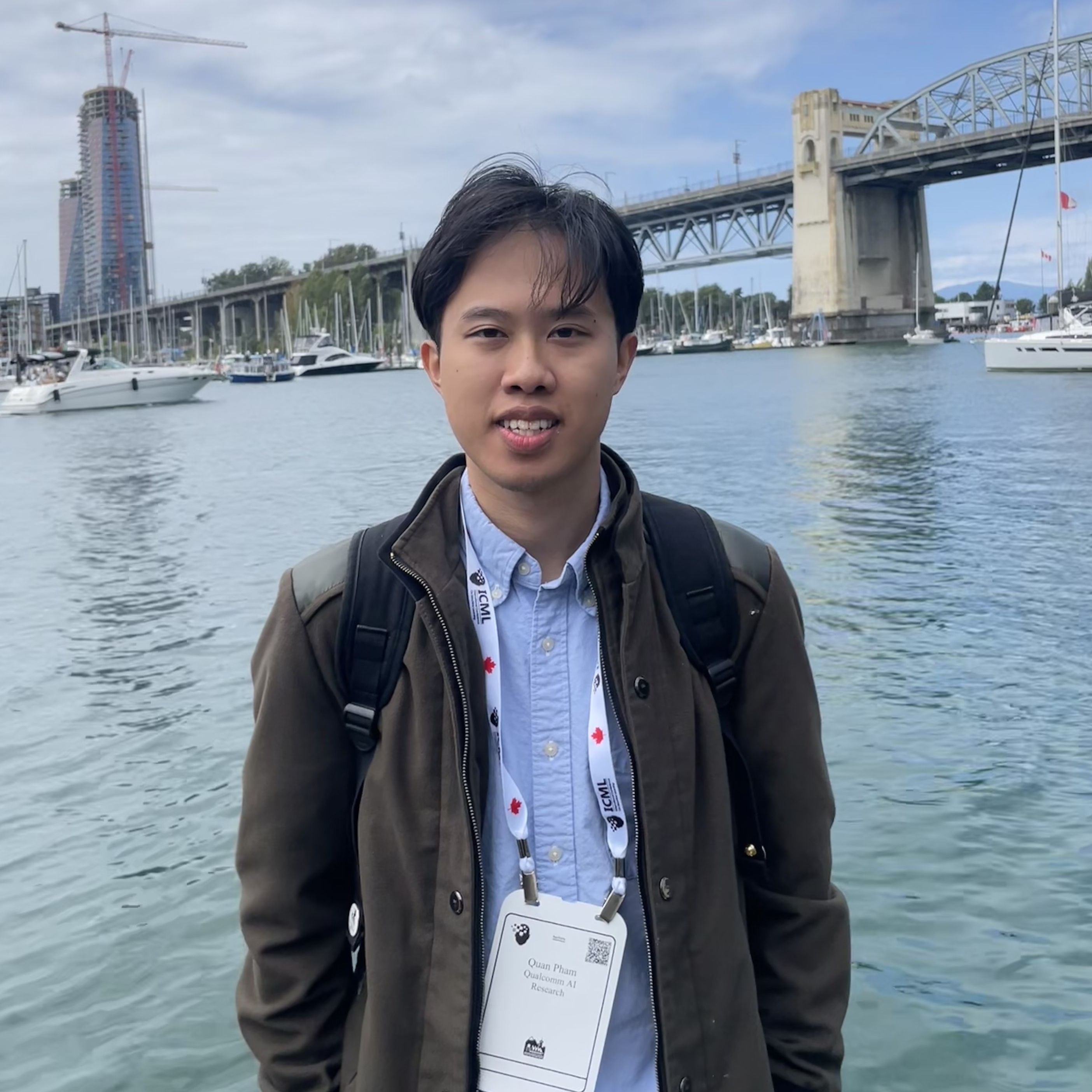
Welcome to my homepage, have a nice day.
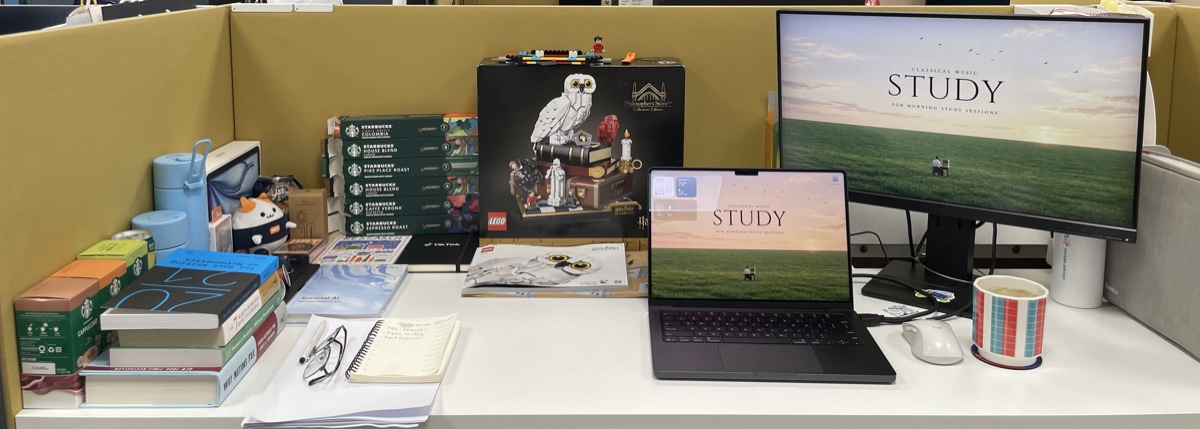
My desk in the lab. I’ll be sitting here for the next four years, so I really enjoy decorating it with my favorite stuff.
About me: Hello world! I’m Quan Pham, a PhD student at the National University of Singapore (NUS), where I am fortunate to be advised by Prof. Wee Sun Lee. Before that, I earned a bachelor’s in Data Science from Hanoi University of Science and Technology, then spent time as an AI Resident at VinAI Research and Qualcomm AI Research.
Most of my days revolve around research, and I really enjoy that rhythm. The repetition does not feel boring to me; instead, it has taught me resilience, patience, and focus. Outside of research, I enjoy playing games, watching films, and, especially, traveling to new places.
My email is quanpham (at) u.nus.edu. For more about me, you can take a look at my resume.
Selected Publications
Writing
Updates
[Jun 2026] One paper was accepted to the ICML 2026 AI4Math workshop.
[Feb 2026] I received PhD admission and a research scholarship from the National University of Singapore.
[Nov 2025] I am actively looking for a PhD position. Good luck to me!
[Jun 2025] I will attend ICML 2025. Let’s connect!
[May 2025] Two papers were accepted to ICML 2025.
[Apr 2025] I joined Qualcomm AI Research as an AI Resident.
[Dec 2024] I achieved an IELTS Academic band score of 7.0!
[Aug 2024] I joined VinAI Research as an AI Resident.
[Apr 2024] My first paper was accepted at ICASSP 2024.
Research Interests
I am interested in self-evolving agents and their applications to scientific research, with the goal of supporting researchers and the broader academic community. I enjoy reading insightful papers line by line and want to spend less time filtering through low-quality AI-generated papers. My current focus is therefore on AI reviewers: how to reliably evaluate their capabilities, integrate them effectively into the peer review process, and use them to support human reviewers as the number of submissions grows rapidly.
I am also really interested in reinforcement learning in general. If you share these interests, I would be happy to collaborate. Feel free to reach out at quanpham (at) u.nus.edu.